0 Results for ""
Mapping the Coordination Layer


Salesforce acquired Slack for $27B, Microsoft embedded Copilot across Teams and Google launched Gemini inside Workspace. Every major platform is adding AI to the communication layer, and yet, most are not asking what happens after the conversation ends. Who tracks what was decided, what was promised, and what actually got done?
In my last post, I argued that the agentic era needs a new infrastructure layer sitting above Slack, a coordination OS that converts communication into structured context, tracked commitments, and executable state. The primitive that could anchor this argument is one that we’ve not yet seen founders building against: a system that tracks a commitment made anywhere (a Slack message, a PR comment, a customer call, an email, a meeting transcript) and automatically turns it into tracked work without anyone creating a task manually. A commitment tracker like this could reduce manual task creation, prevent commitments from falling through the cracks, and create a persistent system of record for how work gets done.
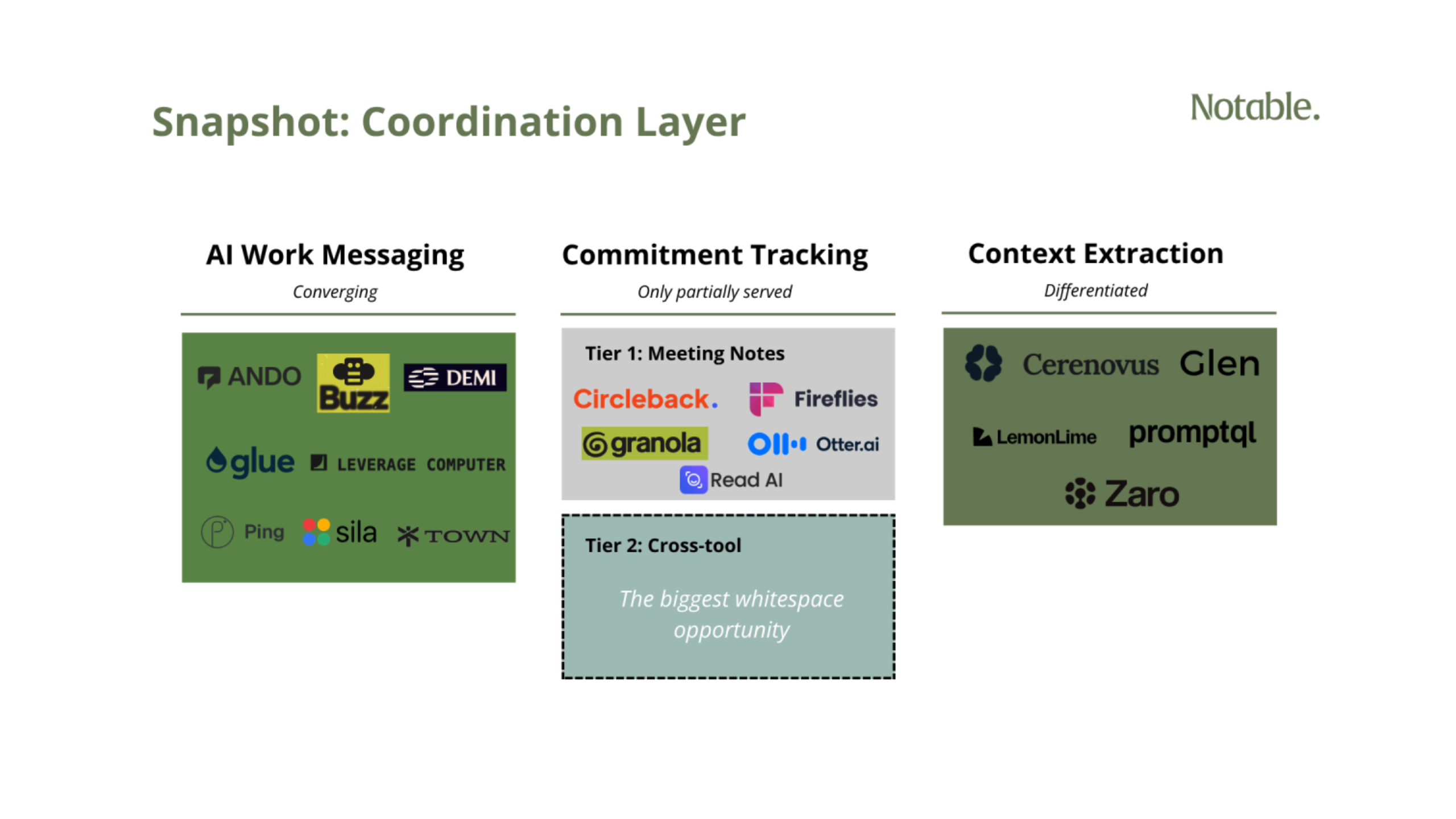
Below we’ve mapped three primary sectors we see today within the coordination layer, they’re not maturing at the same rate, which we believe creates opportunity.
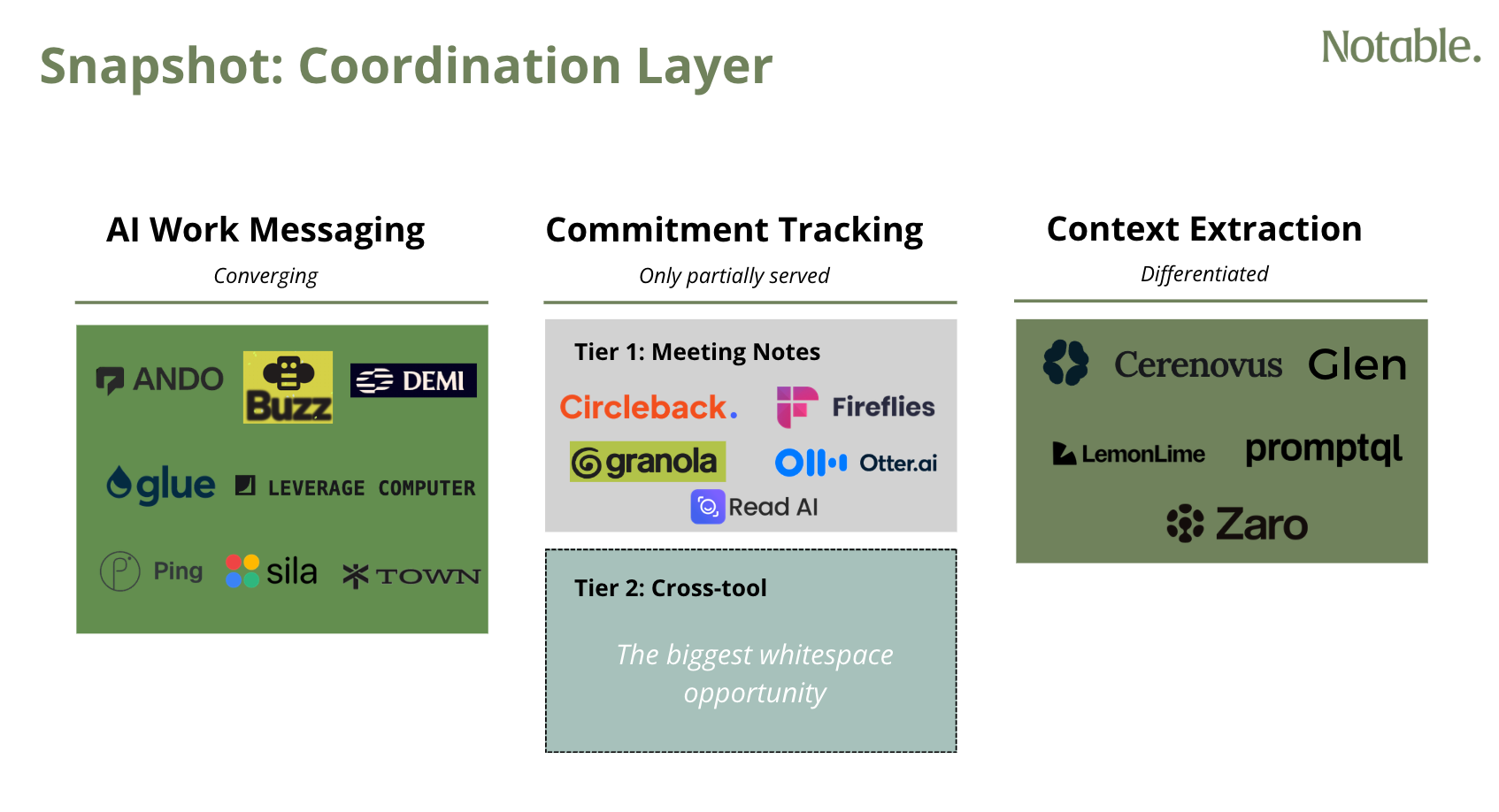
The new work primitives are not being built equally
1. AI work messaging is already crowded
The most populated part of the market map is AI Work Messaging, with teams building an AI-native replacement for, or augmentation of, Slack. This is a new interface where humans and agents work alongside each other.
While each of these companies is taking a differentiated approach to UX, most of them are converging on some variation of “teams and AI work as one” messaging, which looks like:
- “Agent-Native Messaging Platform for modern teams” (Sila)
- “The messaging platform for agent-pilled teams” (Ando)
- “A multiplayer computer for AI-native teams” (Leverage Computer)
That convergence suggests two things: either this is a large opportunity attracting many builders at once or it is a category that hasn’t yet found its wedge and is still figuring out framing. I think both are true. With positioning this similar, the winner won't be decided by messaging; it will be the team with the widest distribution, stickiest data moat within an org, and strongest UX to attract cross-team and departmental collaboration.
Slack's own move to rebrand itself as an "agentic OS," leaning on its existing enterprise footprint and MCP integrations, shows how much incumbency and distribution already matter in this category. Meanwhile, Town, a multi-surface AI assistant spanning Slack, WhatsApp, and Telegram, raised a $55M Series A, a bet on multi-surface reach over a technical moat, validating distribution may matter more than differentiation.
2. Context extraction shows different approaches (for now)
Unlike AI work messaging, where strategies appear to be converging, companies in the context extraction area are so far making different bets on how organizational knowledge should be represented, stored, and retrieved.
Some, like Glean, are building unified context layers that reconcile inputs across Slack, PRs, docs, and meetings, designed to give every agent and human in the stack a complete picture rather than a single slice. Others, like Zaro, are constructing company-wide knowledge graphs from communication and document sources, explicitly designed to feed AI agents operating inside the graph. A third approach, taken by LemonLime, treats the problem as shared memory across scattered corporate data, a platform that unifies institutional knowledge so agents can learn, update, and work from a single source of truth rather than re-deriving context on every query. And at the retrieval layer, teams like Cerenovus are focused on semantic understanding over enterprise data, making existing knowledge findable and actionable without requiring a full graph construction step.
Each of these products is tackling the context extraction problem quite differently: the technical surface area, cross-source reconciliation, and memory architecture vary across teams. That variation is what makes this segment more interesting to evaluate, and harder to predict a winner than simply "who ships fastest."
Unlike messaging, where the user experience is beginning to look similar across products, the architectural choices in context extraction remain meaningfully different. That makes this category both harder to predict than a race to build the best chat interface.
3. Commitment tracking has yet to capture commitments made anywhere
I’ve split commitment tracking into two tiers: meeting notes and cross-tool commitments:
- The first tier: meeting notes and action item extraction is reasonably well-served. Granola, Read AI, Fireflies, Circleback, and Otter AI are all extracting action items from calls after the fact. These are useful products, attacking a targeted version of the problem: a commitment made in a meeting, captured from a transcript. But plenty of commitments are made outside of Zoom’s virtual walls, and the output is a list of action items that still requires someone to manually move them into whatever system the team actually uses and take action on next steps.
- The second tier: cross-tool commitment tracking is nearly empty. The as-yet unaddressed, more challenging infrastructural version of the problem is a commitment made anywhere (a Slack message, a PR comment, a customer call, an email) automatically becoming a structured, tracked work item across every tool the team uses. That means a commitment made in Slack turns into a Linear ticket. A deadline mentioned in a customer call surfaces in the project tracker. A blocker raised in a PR comment gets flagged in the coordination layer without anyone manually creating a task. The white space highlights this as a category that is technically hard to build and less crowded because the accuracy bar is higher.
The open question is whether cross-tool commitment tracking gets built by a new entrant or absorbed by one of the existing layers. Messaging players have a natural wedge in: if you own the channel where commitments are made, tracking them is a seamless expansion, but they don't own the data in Linear, GitHub, or call transcripts. Context extraction players already reconcile inputs across sources, but most optimize for retrieval, not structured commitment extraction. That leaves a real opening for a layer that sits above all of it, ingesting signal from every surface where work gets promised and routing it into whatever execution system the team already uses.
What the Map Tells You About the Opportunity
Taken together, the map suggests a coordination layer evolving at different speeds. AI work messaging is full of activity, with companies converging around a similar buyer narrative despite differentiated products. Context extraction remains architecturally diverse, with teams making different bets on how organizational knowledge should be represented, stored, and retrieved. Commitment tracking, particularly across tools, remains comparatively open.
This indicates to me that the coordination layer is unlikely to be won by a single company or product. Instead, it will emerge as a stack of infrastructure primitives that mature on different timelines.
We're actively looking at companies building across this stack, particularly teams approaching coordination as an infrastructure problem. If you're building in this space, we'd love to talk.