0 Results for ""
How Open Source Stopped Competing With Itself


Open source software has been central to technology’s evolution for over two decades, but the business models underpinning successful open source companies have evolved dramatically (and more favorably). While Red Hat pioneered the services model in the early 2000s, today's most successful open source companies are writing an entirely new playbook, one that's more aligned with customer needs, faster to monetize, and better positioned for the AI era.
Three Generations of Open Source Business Models
The history of open source commercialization can be understood through three distinct generations, each marking an improvement in alignment between customers and software vendors.
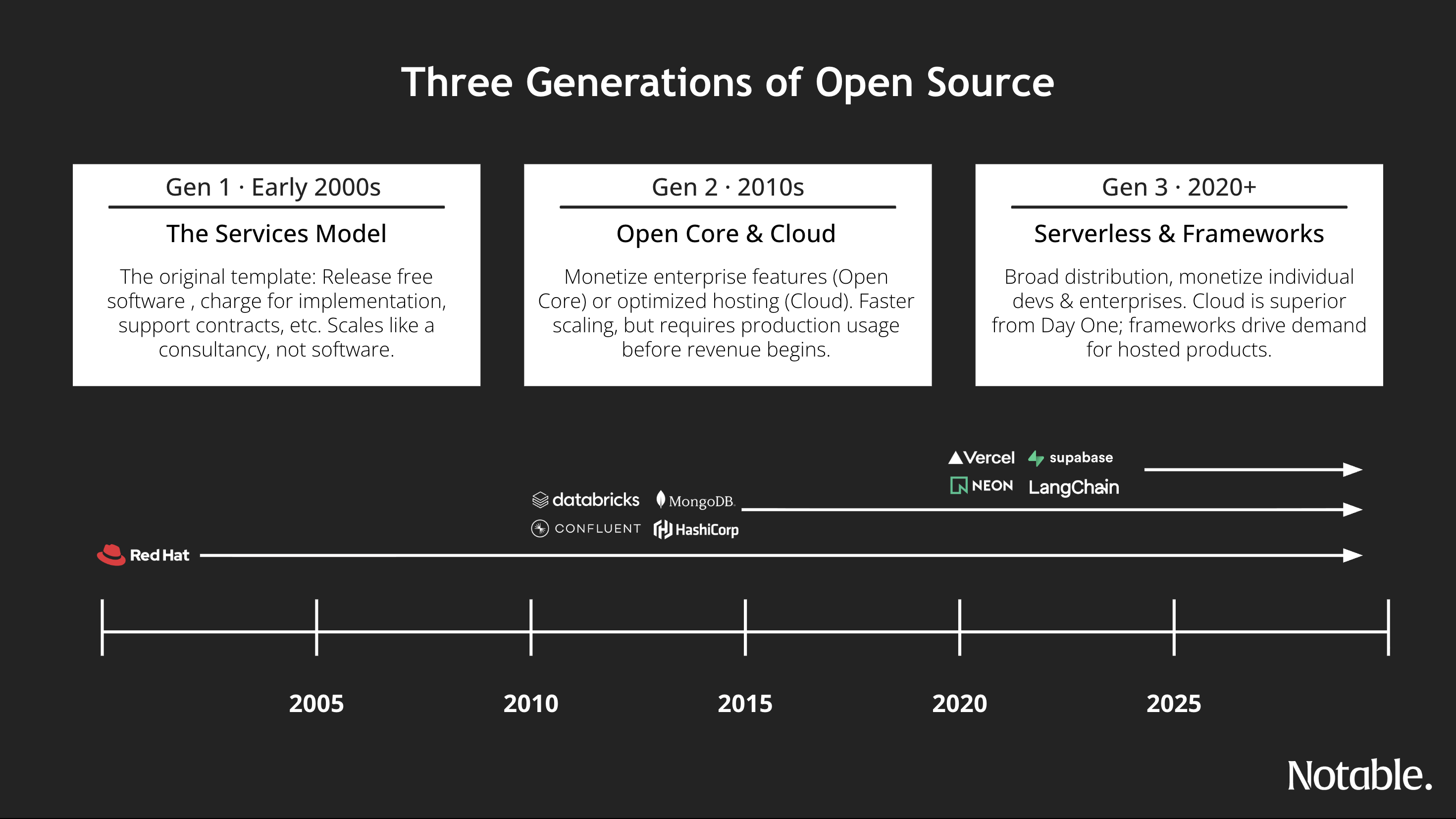
Generation 1: The Services Model
Red Hat established the original template: release open source software, then charge for implementation services, support contracts, and management. This model created real businesses but didn’t improve with scale; they are ultimately services businesses, not software businesses.
Generation 2: Open Core and Cloud
Companies like HashiCorp*, Confluent, Databricks*, and MongoDB evolved the model in two directions. The open core approach released a limited version of the product as open source while keeping key enterprise features behind a paywall. The cloud model offered to run open source software at scale in an optimized cloud environment. These companies scaled faster and larger than their predecessors, with Databricks reaching a $100B+ valuation in a fraction of the time it took Red Hat to reach its peak.
In both cases, the prerequisite to success was the same: scaled production usage within enterprises. These companies monetized efficiently because their products were already running at scale before commercialization. The open source served as proof of concept and distribution channel, with the commercial product following once enterprise adoption was established.
Generation 3: Serverless and Frameworks
Today's open source winners are following a different path, building and improving upon what’s come before. Distribution is still the goal, but it's much more broadly defined. Usage among individual developers and early-stage startups is often as valuable as enterprise adoption. These companies monetize everyone from individual developers to large enterprises, including many who never touch the open source product at all.
Two new models have emerged:
Serverless: Open Source as Marketing
The serverless model, exemplified by companies like Neon and Supabase, represents an evolution of the cloud approach. These startups build cloud services dedicated to efficiently running open source software, but with a crucial difference: economies of scale make the vendor's cloud service practically better on all criteria (including total cost of ownership) from day one.
Rather than waiting for open source to gain traction before monetizing, these companies go to market with a commercial product that's superior from the start. There's little reason to self-host the open source in production. The open source becomes primarily a marketing tool—it builds trust with the developer community and provides an off-ramp if the company fails. Most users start with the cloud version, even though they could run the open source themselves.
Notably, even the previous generation of cloud-first open source companies has moved in this direction. Databricks and MongoDB, while they wouldn't necessarily call themselves serverless open source companies today, have both transitioned almost entirely to serverless offerings—with MongoDB Atlas or Databricks Serverless, the customer no longer needs to think about physical infrastructure, regardless of whose cloud account it’s running in. Their early ties to Spark and MongoDB, respectively, were invaluable for market creation and domination, but the business model has evolved beyond those roots.

Frameworks: Commoditizing Your Complements
The framework model represents a fundamentally different relationship between open source and commercial product. Here, companies build open source tools that aren't prerequisites for adopting the commercial product, but create demand for it.
Vercel's* relationship with Next.js illustrates this perfectly. You can use Vercel without Next.js and you can deploy Next apps without Vercel. But Next works better on Vercel, making the millions of Next.js users a customer acquisition funnel for Vercel. Similarly, Browserbase* open sourced Stagehand, a browser automation framework, and Vercel released the AI SDK.
This strategy borrows from Joel Spolsky's "commoditize your complements" playbook. By making the tools that create demand for your product free, you enable faster growth.
In Vercel’s case, Next.js is at a whopping weekly 33.2M downloads (as of early February), up from 8.6M weekly downloads the same time last year. And their AI SDK is up 7X, from 1.2M weekly downloads last year to 7.7M weekly in February 2026.
"The framework model aligns incentives in a way that open source never had before. That alignment creates a flywheel: the more developers Next.js serves, the more our business grows, and the more we can reinvest into open source development,” Malte Ubl, CTO of Vercel, told us. “The old problem was that the people building open source still needed other jobs to support themselves. With this model, the incentives finally point in the same direction. Great open source is great business, and that means we can fund it sustainably."
The distinction from open core is crucial. In open core models, you can visualize the relationship as concentric circles—the open source is a subset of the commercial product, inevitably becoming its biggest competitor. In the framework model, think puzzle pieces—two distinct but complementary products with a strong "better together" story. Next.js isn't a competitor to Vercel; Stagehand isn't a competitor to Browserbase. They're standalone tools that happen to work harmoniously with their commercial counterparts.
A New Commercialization Playbook
These new business models enable fundamentally different go-to-market strategies than their predecessors:
- Simultaneous Launch Rather than waiting years for open source adoption before commercializing, today's companies often release open source and commercial products simultaneously or with minimal gaps between them. They're businesses from day one, not pseudo-charities turning into businesses.
- Full-Spectrum Monetization Traditional open source companies monetized only the high end of the market—large enterprises with scaled production deployments. Modern open source companies monetize all the way through: individual developers, startups, mid-market companies, and enterprises. This is possible because the commercial product has a strong value prop for customers of all sizes, rather than a suite of enterprise features.
- Maintained Velocity Crucially, these new models preserve the key advantage that made open source powerful in the first place: fast feedback loops. Companies can iterate quickly based on user input, but now they're getting commercial traction earlier from those same individual users, accelerating both product development and revenue growth.
Why This Matters in the AI Era
The shift to serverless and framework models is particularly well-timed for the AI revolution, for two key reasons:
AI Prefers Open Source
AI coding assistants demonstrate a marked preference for open source tools over commercial alternatives, likely due to greater flexibility and more comprehensive documentation. Even if an open source tool isn't run at scale in production, simply being open source increases the likelihood it will be recommended and used by LLMs. As we’ve witnessed firsthand from companies like Neon*, Vercel, and Browserbase are already seeing this effect in their growth metrics.

Developer Brand Amplification
In an era where AI is increasingly intermediating between products and developers, brand awareness and trust matter more than ever. Open source remains one of the most powerful tools for building both, creating mindshare that translates directly into commercial adoption. Codegen accelerates this for trusted open-source brands. Increased shipping speed of open-source contributions means that the best projects continue to get better in public.
Practical Considerations
The serverless model in particular aligns well with how modern infrastructure evolves. Building a reliable service that enterprises will trust to run critical infrastructure takes time and 4 nines uptime isn't achieved overnight. Rather than trying to sell enterprise-grade self-hosted software from day one, these companies start by serving hobbyists and startups while building the reliability that enterprises require. By the time they're ready for enterprise scale, they have both the technical foundation and the market presence to succeed.
The Path Forward
The evolution from services to open core to serverless and frameworks reflects a fundamental shift in how open source creates value—moving from proof of concept to distribution engine to comprehensive growth platform.
Success criteria have changed accordingly. It's no longer about enterprise production users as the singular metric. Today's winners are measured by how many developers their open source touches, regardless of scale or production usage. Open source has become the ultimate product-led growth tool, creating touchpoints across the entire spectrum of potential customers while maintaining the trust and velocity that made it powerful in the first place.
As we look ahead to continued evolution in AI and infrastructure, the companies building on these new open source foundations are well-positioned to define the next generation of technology companies—faster-growing, more customer-aligned, and more resilient than its forefathers.
Thank you to Paul Klein (Browserbase), Malte Ubl (Vercel), and Nikita Shamgunov (Neon) for your input and feedback on this post.